Suppose you're adding features to a site that stores times in local time. You're trying to calculate how many hours it's been since Nov 4, 2007, at 1:30am Eastern. You have to ask the question, Which 1:30am is it? The 1:30am before the clocks rolled back, or the one after?
Suppose a user enters a date and time of Mar 11, 2012, 2:14am. You'd have to return:
ERROR: Time does not exist.
Daylight Savings Time is stupid.
Sunday, July 24, 2011

Monday, May 23, 2011
How My Dad Thinks Modern Civilization Will End
My dad's crazy but he's also a pretty smart guy. Not surprisingly his take on this isn't rapture (even though he's Catholic) or anything I had ever heard before.
My dad thinks that one unlucky day a little chunk of the sun will fly off and hit the Earth at a time when the magnetic field that usually protects it is unusually weak. Then everything electronic on the side of the Earth that happens to be facing the sun that day will burst into flame. Considering that includes the spark plugs in engines - including those in fire engines - it's going to be hard to put those fires out.
It's a pretty strange thing to think about but I can't really say it's impossible or even unlikely.
 The sun is a big continuous explosion. Occasionally some of it flies off in a chunk, and not surprisingly sun bits are really dangerous. Sometimes they just miss us, but sometimes they strike Earth. Or rather, they strike near us - because our magnetic field protects us.
For the past several thousand years, our magnetic field has been shaped like an apple. The indents on the top and the bottom lie at the North and South poles. That means that when sun bits try to hit us they mostly get pushed out and around the Earth, but they have the most impact on the poles where the field is weakest.
 Lately the Earth has been doing something weird, a weird thing it does every hundred thousand years or so - it's swapping the North and South pole. That's right - eventually a compass that points North today will point South instead, and vice versa. If this happened uniformly we would in fact lose our magnetic field entirely for several years and humans would probably be wiped out by mild events in space. Fortunately reality is more complicated, and the pole is actually shifting in parts, so that over time there will be pockets on earth where compasses have flipped, and pockets where it hasn't, and along the boundaries compasses will just point nowhere useful at all - someplace in between.
So for several years along the way our magnetic field will look less like an apple and more like cloud tops - lots of random bumps all over of normal or reversed field. Eventually "reversed" will become the new normal and everything will stabilize.
So the problem is what if a bit of the sun flies at us during that time where the boundaries between these fields aren't isolated to just 2 points at the top and bottom of the earth, but rather when they trace trails all over the earth, and expose large sections of it that directly face the sun?
Probably a big disaster for anyone who likes electronics. Or not being on fire (I'm a Fan).
My dad thinks that one unlucky day a little chunk of the sun will fly off and hit the Earth at a time when the magnetic field that usually protects it is unusually weak. Then everything electronic on the side of the Earth that happens to be facing the sun that day will burst into flame. Considering that includes the spark plugs in engines - including those in fire engines - it's going to be hard to put those fires out.
It's a pretty strange thing to think about but I can't really say it's impossible or even unlikely.
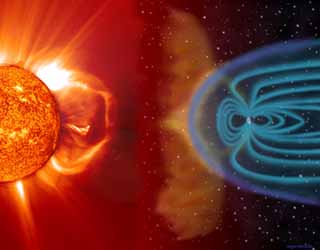 The sun is a big continuous explosion. Occasionally some of it flies off in a chunk, and not surprisingly sun bits are really dangerous. Sometimes they just miss us, but sometimes they strike Earth. Or rather, they strike near us - because our magnetic field protects us.
For the past several thousand years, our magnetic field has been shaped like an apple. The indents on the top and the bottom lie at the North and South poles. That means that when sun bits try to hit us they mostly get pushed out and around the Earth, but they have the most impact on the poles where the field is weakest.
 Lately the Earth has been doing something weird, a weird thing it does every hundred thousand years or so - it's swapping the North and South pole. That's right - eventually a compass that points North today will point South instead, and vice versa. If this happened uniformly we would in fact lose our magnetic field entirely for several years and humans would probably be wiped out by mild events in space. Fortunately reality is more complicated, and the pole is actually shifting in parts, so that over time there will be pockets on earth where compasses have flipped, and pockets where it hasn't, and along the boundaries compasses will just point nowhere useful at all - someplace in between.
So for several years along the way our magnetic field will look less like an apple and more like cloud tops - lots of random bumps all over of normal or reversed field. Eventually "reversed" will become the new normal and everything will stabilize.
So the problem is what if a bit of the sun flies at us during that time where the boundaries between these fields aren't isolated to just 2 points at the top and bottom of the earth, but rather when they trace trails all over the earth, and expose large sections of it that directly face the sun?
Probably a big disaster for anyone who likes electronics. Or not being on fire (I'm a Fan).
Friday, April 8, 2011
Limb Regeneration - We Can Have It If Evolution Goes Backwards
P21 Knockout Mice - mice with a gene named p21 removed from their DNA - can have a leg cut off and it will regrow in a matter of months.
Gene p21 has 3 seeming evolutionary benefits. First, it causes you to heal sooner - you end up with a big scar instead of a limb, meaning a less vulnerable area for a smaller amount of time. Second, it causes you to heal more cheaply - regrowing limbs costs a lot in terms of food, right when you're probably pretty crappy at obtaining food. And third, regrowing anything is probably going to make you more susceptible to cancer.
So the first 2 are all about food. In our overfed environment, I wonder if some humans will just happen to devolve and end up with a damaged p21 that unlocks the limb regeneration already in our DNA. We already have many segments of the population that arguably have degraded genes - people who can't digest certain foods or are unusually susceptible to certain diseases. It's not that strange to think that this gene could also degrade. Who knows - maybe we already have humans with this degradation - they just haven't had any limbs cut off.
Thursday, April 7, 2011
Mancakes
me: Man, I switched my pancake recipe over to whole wheat
So much more delicious
There is a bit of wheaty taste that I'm not in love with but I bet I can smooth that out with more tweaking
But the texture, soooooo gooooood
Bramlage: Hahahaha, I'm glad you enjoy
But yeah, its pretty common in recipes with wheat flour
To actually split it wheat and all purpose 50/50
You could give that a try?
me: Yeah I was gonna pussy out like that
But then I checked my pants
And found a set of BALLS
Saturday, March 26, 2011
Health Insurance Needs Consumer Testing Legalized
Right now, if you were to file a test claim with your insurance company to verify they'd actually fill it if you got cancer, they'd be able to sue you for a substantial amount of money - even if you gave the claim money back in say, three days, just to verify they really followed-through on their promises. That needs to change.
A mattress salesman once told me that a mattress typically sells for 3-4x what it costs, and that for the most part, none of them are very good. Often people pay extra for features they don't understand or need. Compare this to groceries at the grocery store. These goods arrive and are sold for razor thin margins - and the quality tends to be very high.
So why are mattresses expensive low-quality items, and groceries nice things you buy for very little? Frequency. You buy groceries over and over, so when you go to buy an apple or a can of beans next time, you have a strong idea of the value you're getting. You also buy them so often that each time you go to purchase them, you can go to a different vendor to look for better prices, and better quality goods. Each purchase is a chance to optimize the cost and quality of the product in your favor, and better informs you of the relative value you're getting.
Obviously a mattress is the opposite. Someone buying a mattress is unlikely to ever come back. You buy mattresses so rarely you don't really know what to look for in one mattress to the next. You also have essentially no concept of what a "good" price for a mattress is, because you have very little experience buying them. As market forces go, the value is going to tend to be low and the price high because the consumer is inexperienced at making this purchase. In summary, the frequency with which consumers buy and receive a product has a linear correlation with the value delivered for cost.
So now let's consider health insurance. Health insurance may be a perversion of this model. In some ways, health insurance is similar to groceries - many health claims pay out in small ways frequently, like covering a simple doctor's visit. But these small claims generally don't add up to enough to account for the premiums you pay in. These are not what you're actually paying for, and if you were, you'd be easily able to shop around for something a lot cheaper than the typical cost of health insurance.
What you're paying for is calamity protection. Cancer, a car accident with broken limbs, a life-threatening disease - something that puts you in the hospital. Fortunately, this happens to you infrequently. Yet unfortunately, that means the value for the money spent is also delivered to you infrequently. This means that you don't know what you're going to get. You probably don't even know how much say, a week in the hospital would cost - or 3 months of cancer treatment.
The worst case scenario for the market economy model is one where the only time the consumer's promise comes due is a time when they are at their absolute worst to demand it. It's really horrible to think about, but when an insurance company is barely scraping by and someone who has 3 months to live files for a massive claim the company can't afford, what if the insurance company just delays payment? The patient is more likely to die and both the risk of lawsuit and the risk of additional claims filed goes away. The insurance company has every economic reason to act against the consumer. How often this occurs is something I'll leave to others, but what's clear is a really awful incentive exists in this very specific scenario for this very specific product - just about as far from the grocery-buying scenario as you can get.
So what we need is to be able to get that value tested more often. You'll never be able to test health insurance as often as you verify the value of the apples at your local grocer, but we could bring market forces back into alignment if we make it legal for any journalist, or everyday citizen who wants to play the role of one, to test their insurance for calamity protection. Here's my proposal:
Any false medical insurance claim filed with the intent of testing one's insurance is not insurance fraud. If a test claim is paid in full, the payment must be returned within 3 days of the final portion of the claim payment being completed, or the claim returns to being treated as insurance fraud.
You might be saying, what if we suddenly had a deluge of fraudulent claims and people just kept the money? Well, this doesn't make it OK to keep the pay out - it makes it OK to file a claim while you're healthy and able to follow all the paperwork and hurdles before you, and then if the insurer ever pays out - give it back. Keeping it for longer than 3 days leaves you with existing law and today's existing situation - and today there is insurance fraud, but nothing so out of control that the industry can't keep up with it.
Second, you might say this risks people filing these sorts of claims in order to obtain a large 3-day loan. This is a somewhat obscure possibility, but consider that typically a medical insurance claim doesn't actually get paid to the patient - it gets paid to the medical service providers that performed the work. So to turn this into a useful 3-day loan, a medical services provider would need to convince a patient to file a test claim. It is possible that a shady doctor or hospital might do so - so let's add a clause that adds fines for such coercion:
Any medical provider who financially benefits from coercing a health insurance consumer into performing a test claim is subject to a fine triple the financial gain they accrued.
Finally, you might worry that consumers do this en masse and the number of claims filed with insurers doubles. But what's the incentive? If something is difficult, it doesn't happen very often. Coordinating an authentic-looking test claim to test the insurers is going to require a lot of coordination. A lot of fake paperwork is going to have to travel from multiple service providers to the insurance companies, and part of that coordination is that they're going to have to return their share of the payout. It's likely that only a well-organized existing group like Dateline could even put this together, but the door is left open for a very intrepid consumer who wants to test their insurance (and has quite a bit of time on their hands) can do so as well. Nonetheless, we should limit these to a reasonable level to prevent unforeseen consequences - let's add a limit clause:
Any beneficiary of test claims may not participate in more than 4 per year, paid or unpaid. Test claims in excess of this limit are fraud.
Market economies work best when the consumer can verify the value of what they buy often. Government works best when it intervenes only in case of an exception - of a dispute. This proposed law lets consumers, rather than government watchdogs, verify their own purchase's validity anytime they're willing to put in the work, and only if they keep the money or the insurer breaks their promises does the government have to get involved (via a lawsuit in either direction). So let's get a law in place that lets healthy people test their insurance - before they're too sick to fight.
Subscribe to:
Posts (Atom)